

Injured in an Accident? We Can Help. Call for a Free Consultation. 24/7
212-808-8092Injured in an Accident? We Can Help. Call for a Free Consultation. 24/7
212-808-8092New York construction labor laws give injured workers some of the most powerful legal rights in the country. Attorney Brett J. Nomberg, of the Law Office of Brett J. Nomberg, PLLC, at 600 Third Avenue, New York, NY, has enforced these laws on behalf of construction workers for more than 30 years.
New York’s Labor Law §240, §241(6), and §200 create legal claims unavailable in any other state — including the “Scaffold Law,” which places absolute liability on property owners and contractors for falls and falling object injuries, regardless of whether the worker was partly at fault. Understanding these laws is the first step toward full recovery.
In 2024, New York City recorded 638 construction incidents and 7 fatalities. Falls remain the leading cause, accounting for 58% of all NYC construction worker deaths. Despite the strength of New York’s Construction Labor Laws and their protections, most injured workers never receive full compensation — because they do not know which laws apply to their injury, which parties beyond their employer are liable, or how the third-party lawsuit process works alongside their workers’ compensation claim.
Labor Law §240 and Labor Law §241(6) are among the most valuable and most misunderstood statutes in New York personal injury law.
New York construction workers injured on the job can pursue two simultaneous legal paths. Workers’ compensation under New York Workers’ Compensation Law covers medical expenses and partial wage replacement — but bars direct lawsuits against your direct employer.
Third-party personal injury claims under Labor Law §240, §241(6), and §200 can be brought against property owners, general contractors, and other parties on the job site — and these claims carry no statutory cap on damages. If a government-owned or government-controlled job site is involved, a Notice of Claim under General Municipal Law §50-e must be filed within 90 days. Private claims must be filed within three years under CPLR §214.
Brett Nomberg Law offers free consultations with no attorney fee unless you win. If you were injured due to someone else’s negligence, the Top New York Personal Injury Attorney is ready to hear your story. Call anytime — 24 hours a day, 7 days a week.
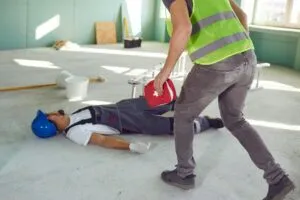
New York Construction Labor Laws provides three statutes specifically protecting construction workers from the most common causes of serious injury and death on job sites. These laws work together and are often all cited in a single construction accident lawsuit.
Labor Law §240 — commonly called the Scaffold Law — is the most powerful worker protection statute in New York. It requires all contractors and property owners to provide adequate scaffolding, hoists, ladders, slings, hangers, pulleys, stays, and ropes for workers performing work at elevation.
When a worker falls from height or is struck by a falling object and the injury is caused by a §240 violation, the contractor and property owner are absolutely liable — meaning they cannot defend themselves by arguing the worker was at fault or contributed to the accident.
This absolute liability standard is unique to New York and does not exist in any other state. It covers work including erection, demolition, repair, alteration, painting, cleaning, and pointing of buildings or structures.
Labor Law §241(6) requires owners and contractors to comply with specific safety rules set forth in the New York State Industrial Code (12 NYCRR Part 23). Unlike §240’s absolute liability, a §241(6) claim requires proving that a specific Industrial Code provision was violated and that the violation caused the injury.
However, it is a powerful statute because it covers a wide range of job site hazards — including floor conditions, equipment operation, trenching, demolition, and hoisting — and allows injured workers to sue owners and contractors directly, even when their own employer’s negligence contributed. Common Industrial Code violations cited include IC §23-1.7(b) (floor openings), §23-1.21 (ladder safety), §23-5.1 (scaffold construction), and §23-9.2 (power equipment).
Labor Law §200 codifies the common-law duty of owners and contractors to provide construction workers with a reasonably safe place to work. Unlike §240 and §241(6), which are strict liability statutes tied to specific conditions or code violations, §200 requires proof that the defendant had authority to control the work or the condition that caused the injury, and knew or should have known about the dangerous condition.
It applies broadly and is frequently cited alongside §240 or §241(6) in construction accident lawsuits — particularly where a general contractor’s supervisory negligence contributed to the injury.
These protections apply broadly to workers on covered construction projects:
Excluded: Owners of one- and two-family dwellings who do not direct or control the work are exempt from §240 and §241(6) liability under the homeowner exemption. This exemption does not apply to multi-family buildings, commercial properties, or homeowners who exercise supervisory control over the work.
| Party | Liability Under §240 | Liability Under §241(6) | Liability Under §200 |
|---|---|---|---|
| Property owner (commercial/multi-family) | Absolute — regardless of fault | Yes — if Industrial Code violated | Yes — if knew or should have known of hazard |
| General contractor | Absolute — regardless of fault | Yes — if Industrial Code violated | Yes — if supervised the work or the hazard |
| Subcontractor | May apply if they supervised the specific work | Yes — if they controlled the violating condition | Yes — if they controlled the hazard |
| Equipment manufacturer | Not directly — but product liability applies | Potentially under defective equipment Industrial Code provisions | Not directly |
| Owner of 1-2 family dwelling | Exempt if did not direct or control work | Exempt if did not direct or control work | Standard negligence applies |
Beyond New York’s Construction Labor Laws, construction workers are protected by federal OSHA standards (29 CFR Part 1926) and New York State’s Public Employee Safety and Health (PESH) regulations administered by the NY Department of Labor.
OSHA’s key construction standards address fall protection (requiring systems at 6 feet or more), scaffold construction and load capacity, ladder safety and angle requirements, excavation and trench protection, crane and derrick operation, and lockout/tagout procedures for electrical hazards. OSHA violations can be used as evidence in third-party lawsuits to demonstrate that safety standards existed, were known, and were disregarded.
New York construction accident lawyers regularly subpoena OSHA inspection records and violation histories to build negligence cases.
| Question | Answer |
|---|---|
| What makes Labor Law §240 “absolute liability”? | Under §240, if a contractor or owner fails to provide adequate fall protection or protection from falling objects, they are liable for the resulting injury — even if the worker contributed to the accident. The worker’s comparative negligence is not a defense. |
| Does §240 cover all falls at construction sites? | No. §240 covers gravity-related falls and falling object injuries tied to the specific risks of construction work at elevation. Falls on the same level, such as a trip on a flat floor, are not covered by §240 — those fall under §241(6) or §200. |
| What is the Industrial Code and why does it matter? | The New York State Industrial Code (12 NYCRR Part 23) contains specific safety requirements for construction sites. Violating a specific provision and causing an injury creates liability under Labor Law §241(6) — a stronger claim than general negligence. |
| Can I sue under Construction Labor Laws if I am undocumented? | Yes. New York’s Labor Law protections apply to all workers performing covered construction work regardless of immigration status. Courts have consistently upheld these rights. |
| Does the homeowner exemption apply to a landlord renting out a building? | No. The one- and two-family dwelling exemption only protects owner-occupants who do not direct or control the work. Landlords, investors, and absentee owners of residential property do not qualify for the exemption. |
| How long do I have to file a Labor Law §240 claim? | Three years from the date of the accident under CPLR §214 for private property owners. If a public entity owns the site, a Notice of Claim under GML §50-e must be filed within 90 days — missing this deadline bars your claim against that entity. |
Brett Nomberg personally handles every single case from trial through appeals. Speak directly to your lawyer—even on weekends. No attorney fee unless we win.

Brett J. Nomberg has practiced personal injury and construction accident law in New York for more than 30 years. He personally manages every case — clients speak directly with Brett, never a paralegal or junior associate. He is available 24 hours a day, 7 days a week.
His record includes $3.65 million for a construction accident and $3.2 million for a Queens construction worker, both built on aggressive enforcement of New York’s Construction Labor Laws. Learn more at his attorney profile page. He also handles workers’ compensation, brain injury, and wrongful death cases arising from construction accidents.
If you were injured on a New York construction site, you have rights that most workers never fully pursue. Visit brettnomberglaw.com, call (212) 808-8092 any time — 24/7 — or reach us through our online contact page. There is no fee unless we win.

600 Third Avenue, 2nd floor
New York, NY 10016
Call us today to discuss your case. The consultation
is free and there is no fee unless we win.
"*" indicates required fields
DISCLAIMER: This is Attorney Advertising in compliance with NYS Ethical rules. This website is meant for general information and not legal advice. No
attorney-client relationship exists by viewing this website or submitting an email. There is no attorney fee if not successful. Under NYS law a client is responsible for
legal expenses at the conclusion of the case. Past outcomes do not guarantee every case will be successful.
© 2026 Law Office of Brett J. Nomberg, PLLC• All Rights
Reserved. | Site Map | Privacy Policy. Digital Marketing By:  *Images are obtained under license from Canva and other third-party stock image providers, with
attribution included where required.
*Images are obtained under license from Canva and other third-party stock image providers, with
attribution included where required.