

Injured in an Accident? We Can Help. Call for a Free Consultation. 24/7
212-808-8092Injured in an Accident? We Can Help. Call for a Free Consultation. 24/7
212-808-8092
Types of car accidents in New York vary widely — from rear-end crashes on congested highways to head-on collisions on undivided rural roads. Attorney Brett J. Nomberg, of the Law Office of Brett J. Nomberg, PLLC, at 600 Third Avenue, New York, NY, represents victims injured in every category of crash across all five boroughs and surrounding counties. The type of collision directly shapes which evidence matters most, which parties may be liable, and how damages are calculated. Understanding your crash type is the foundation of building a strong personal injury case.
In New York City alone, over 91,000 motor vehicle collisions were recorded in 2024. Rear-end crashes account for nearly 42% of all vehicle collisions nationally, making them the single most common crash type in high-traffic environments like New York City streets. Head-on collisions, while representing just 2% of all crashes, account for over 10% of all driving fatalities nationally — due to the extreme combined-speed forces involved. T-bone accidents are among the leading causes of severe injury at New York City intersections, where failure-to-yield violations are cited in nearly 4,700 crashes annually per NYPD data.
New York’s no-fault insurance system under Insurance Law §5103 provides up to $50,000 in basic economic loss coverage regardless of crash type. To pursue a lawsuit against the at-fault driver, your injuries must meet the serious injury threshold under Insurance Law §5102(d) — including a fracture, permanent limitation, significant disfigurement, or 90/180-day disability. If a government vehicle or road defect contributed to any type of crash, a Notice of Claim must be filed within 90 days under General Municipal Law §50-e. The standard statute of limitations for private claims is three years under CPLR §214.
Brett Nomberg Law offers free consultations with no attorney fee unless you win. If you were injured due to someone else’s negligence, the Top New York Personal Injury Attorney is ready to hear your story. Call anytime — 24 hours a day, 7 days a week.
Each category of crash creates different liability questions, different evidence requirements, and different insurance dynamics. A rear-end collision almost always places presumptive fault on the following driver, while a sideswipe on the BQE may involve disputed lane-change evidence that requires dashcam footage or cell records. A rollover on an SUV may involve a product liability claim against a manufacturer in addition to a negligence claim against another driver. Brett Nomberg evaluates every angle of liability from the first call. See his verdicts and settlements to understand how thorough case preparation produces results.
| Crash Type | How It Happens | Common Injuries | Key Legal Issues |
|---|---|---|---|
| Rear-end collision | Front of one vehicle strikes rear of another; often caused by distracted or following-too-closely driving | Whiplash, herniated discs, TBI, soft tissue | Presumptive fault on rear driver; cell records for distracted driving |
| Head-on collision | Two vehicles strike front to front; typically on undivided highways, wrong-way driving, or DWI | TBI, spinal fractures, internal bleeding, fatalities | Extreme injury severity; DWI criminal + civil liability; wrongful death claims |
| T-bone / broadside (intersection) | Side of one vehicle struck by front of another at an intersection; failure to yield or red-light violations | Rib fractures, pelvic injuries, head trauma | Intersection camera footage; signal timing records; NYPD crash report |
| Sideswipe | Two vehicles traveling parallel make side contact; improper lane changes, merges, or congested traffic | Soft tissue, shoulder injuries, loss-of-control secondary crashes | Dashcam or witness evidence of lane change; disputed fault common |
| Rollover | Vehicle flips onto its side or roof; common with SUVs on curves, highway ramps, or after a sideswipe | Spinal cord injury, TBI, crush injuries, fatalities | Product liability if vehicle defect contributed; EDR / black box critical |
| Multi-vehicle pileup | Three or more vehicles involved; common on highways in fog, ice, or congested conditions | Compounding injuries from multiple impacts | Multiple liable parties; shared comparative fault under CPLR §1411 |
| Hit-and-run | At-fault driver flees the scene; leaving the scene of an accident is a crime under NY VTL §600 | All injury types; no immediate at-fault driver | MVAIC claim; UM coverage; camera/witness evidence to identify fleeing driver |
| Rideshare crash (Uber / Lyft) | TNC vehicle involved during app-active or fare period | All injury types | TNC insurance layers (up to $1M during fare); vicarious liability questions |
| Pedestrian knockdown | Vehicle strikes a person in a crosswalk, on a sidewalk, or at an intersection | Fractures, TBI, spinal damage, fatalities | Failure to yield; serious injury threshold easily met; NYPD Vision Zero data |
| Bicycle crash | Vehicle strikes a cyclist; dooring, turning across bike lane, or failing to yield | Fractures, road rash, TBI, internal injuries | NYC bike lane violation; cyclist comparative fault disputed; helmet use evidence |
| Road defect / vehicle defect crash | Pothole, missing sign, brake failure, or tire blowout contributes to crash | All injury types depending on impact | Municipal liability (90-day Notice of Claim); product liability vs. manufacturer |
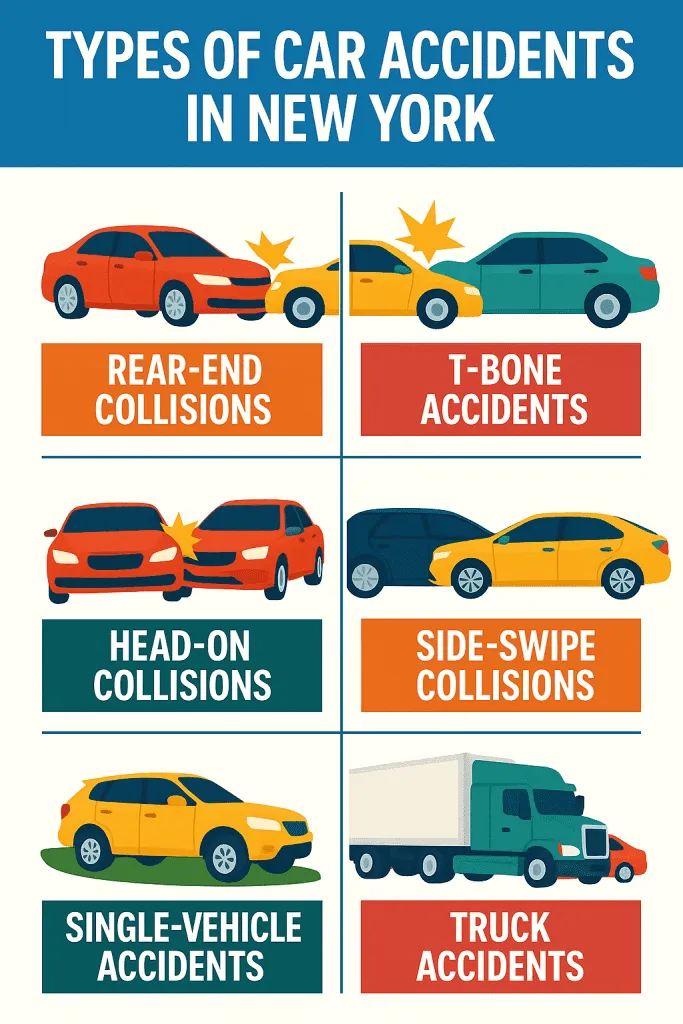
Rear-end accidents account for nearly 42% of all vehicle collisions and are the most common crash type on New York roads. They are frequently caused by distracted driving — the leading cause of all NYC crashes — as well as following too closely and sudden braking in heavy traffic. While fault typically falls on the rear driver, insurers often dispute injury severity, particularly in lower-speed impacts. New York car accident cases involving rear-end impacts frequently include whiplash, herniated discs, and traumatic brain injuries — injuries that may not be apparent for days after the crash.
Head-on collisions represent just 2% of all crashes nationally but account for more than 10% of all driving fatalities — because the combined speed of two vehicles colliding front-to-front creates forces no safety system can fully absorb. On undivided New York State highways and wrong-way highway ramps, these crashes are especially deadly. T-bone accidents — where one vehicle strikes the side of another at an intersection — are particularly common at New York City’s most dangerous intersections. The side door of a vehicle offers far less crash protection than the front or rear, making these collisions a frequent cause of spinal cord injuries and pelvic fractures.
Rollover accidents are among the most deadly crash types, and SUVs — which sit higher and carry more weight — are disproportionately prone to rolling in sharp turns, highway ramps, or following a sideswipe impact. Beyond standard negligence claims, rollovers may trigger product liability claims if a vehicle defect contributed to instability. Hit-and-run crashes are prosecuted criminally under NY VTL §600 and may be compensated through your own UM coverage or New York’s MVAIC fund. Rideshare crashes involve complex TNC insurance layers — Uber and Lyft must carry up to $1 million in coverage while a fare is active — and Brett Nomberg knows how to pursue every available dollar from these policies.
| Question | Answer |
|---|---|
| What is the most common type of car accident in New York? | Rear-end collisions are the most common, accounting for nearly 42% of all vehicle crashes nationally. In NYC, driver inattention and distraction are cited in over 12,000 crashes per year — the leading contributing factor. |
| Who is at fault in a T-bone accident? | Usually the driver who failed to yield, ran a red light, or failed to observe a stop sign. Intersection camera footage, the police report, and witness statements are the most important evidence in T-bone cases. |
| Can I sue if I was hit by an Uber or Lyft driver? | Yes. TNC companies carry commercial insurance coverage of up to $1 million while a fare is active. Brett Nomberg can identify which insurance layer applies based on the app status at the time of the crash. |
| What if the driver who hit me fled the scene? | You may file a claim through your own uninsured motorist (UM) coverage or through MVAIC, New York’s fund for victims of uninsured and hit-and-run drivers. |
| Are rollover accidents always caused by another driver? | Not always. While sideswipes and T-bone impacts can trigger rollovers, many involve single vehicles. If a vehicle design defect caused or contributed to the rollover, a product liability claim against the manufacturer may apply. |
| How long do I have to file a lawsuit after a car accident in New York? | Three years from the crash date under CPLR §214 for private parties. If a government vehicle or public road defect was involved, a Notice of Claim must be filed within 90 days under GML §50-e. |
Brett Nomberg personally handles every single case from trial through appeals. Speak directly to your lawyer—even on weekends. No attorney fee unless we win.

Brett J. Nomberg has practiced personal injury law in New York for more than 30 years. He personally manages every case at his firm — clients speak directly with Brett, never just a paralegal or case manager. He is available 24 hours a day, 7 days a week, including weekends and holidays. His record includes a $4.5 million verdict for a brain injury, $3.9 million in a case where evidence was concealed, $3.65 million for a construction accident, and $1.7 million in a case involving a hidden surveillance tape. All cases are handled on contingency — no fee unless Brett wins. Learn more at his attorney profile page. Brett handles all car accident, pedestrian accident, catastrophic injury, and wrongful death cases for crash victims across New York.
Every crash type creates different legal questions, different evidence, and different liable parties. Visit brettnomberglaw.com, call (212) 808-8092 any time — 24/7 — or reach us at our online contact page. There is no fee unless we win.

600 Third Avenue, 2nd floor
New York, NY 10016
Call us today to discuss your case. The consultation
is free and there is no fee unless we win.
"*" indicates required fields
DISCLAIMER: This is Attorney Advertising in compliance with NYS Ethical rules. This website is meant for general information and not legal advice. No
attorney-client relationship exists by viewing this website or submitting an email. There is no attorney fee if not successful. Under NYS law a client is responsible for
legal expenses at the conclusion of the case. Past outcomes do not guarantee every case will be successful.
© 2026 Law Office of Brett J. Nomberg, PLLC• All Rights
Reserved. | Site Map | Privacy Policy. Digital Marketing By:  *Images are obtained under license from Canva and other third-party stock image providers, with
attribution included where required.
*Images are obtained under license from Canva and other third-party stock image providers, with
attribution included where required.