

Injured in an Accident? We Can Help. Call for a Free Consultation. 24/7
212-808-8092Injured in an Accident? We Can Help. Call for a Free Consultation. 24/7
212-808-8092
Pedestrian accidents in New York are caused overwhelmingly by driver negligence — not pedestrian error. Understanding what causes these collisions, and what injuries they produce, matters both for public safety and for anyone evaluating a legal claim after being struck. Brett J. Nomberg represents injured pedestrians throughout New York City and the surrounding area. This page explains the most common causes of pedestrian accidents in New York, the injuries they typically produce, and why the connection between cause and injury matters in a personal injury case.
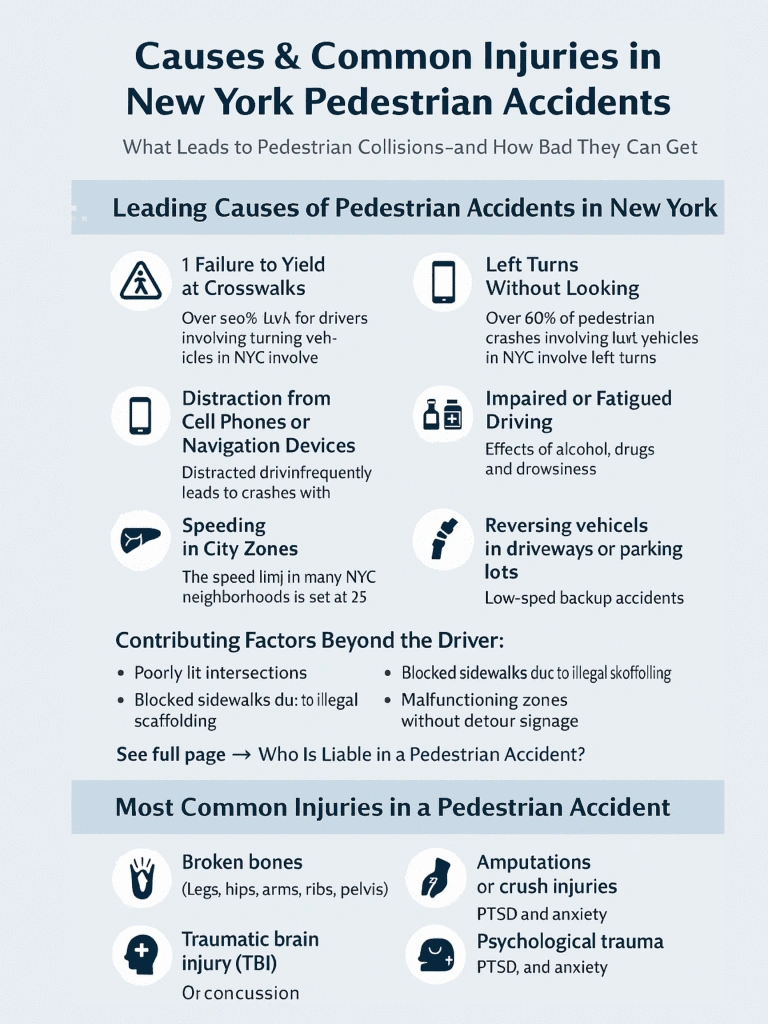
The causes of pedestrian accidents in New York follow a consistent pattern documented by NYC DOT, NHTSA, and law enforcement data. Driver inattention, failure to yield, and speeding account for the majority of pedestrian fatalities and serious injuries citywide. These are not accidents in the everyday sense of the word — they are foreseeable outcomes of specific, negligent driving choices. Each cause has a direct legal counterpart: a breach of the duty of care that New York law imposes on every driver.
The injuries that result from these collisions range from soft tissue sprains to traumatic brain injuries, spinal cord damage, and fatal trauma. The severity of any given injury depends on vehicle speed, the point of impact on the pedestrian’s body, and the pedestrian’s age and physical condition at the time. For a detailed breakdown of injury types and how they affect the value of a legal claim, see Pedestrian Accident Injury Types. For an explanation of liability and what damages are available, see Pedestrian Accident Liability and Damages.
Outcomes in individual cases depend on the evidence, the nature of the injuries, and the specific facts of the collision. Brett J. Nomberg investigates each case from the point of cause — identifying the driving behavior that led to the crash and connecting it to the harm suffered — before any settlement discussions begin.
Brett Nomberg Law offers free consultations with no attorney fee unless you win. If you were injured due to someone else’s negligence, the Top New York Personal Injury Attorney is ready to hear your story. Call anytime — 24 hours a day, 7 days a week.
Driver inattention is the single most frequently cited contributing factor in New York City traffic crashes. In 2023 alone, it was recorded in over 12,190 crash incidents in the city — appearing as a factor in roughly 29.8 percent of all collisions. NYC DOT has documented that dangerous driver choices including inattention account for the majority of pedestrian accident fatalities.
Distraction takes many forms behind the wheel. Texting and phone use are the most widely recognized, but eating, adjusting GPS systems, interacting with passengers, and daydreaming all constitute distracted driving. A driver whose eyes leave the road for even two seconds at 25 mph travels the length of roughly half a city block without looking. At the density of New York City streets — where pedestrians enter crosswalks, step between parked vehicles, and cross at unmarked locations constantly — that lapse is frequently enough to cause a serious collision.
Under New York law, a driver who strikes a pedestrian while distracted has breached the duty of care established by Vehicle and Traffic Law § 1146. That breach is negligence, and it is the foundation of a pedestrian accident claim. Evidence of distraction — cell phone records, witness accounts, surveillance footage — can be decisive in establishing liability.
Failure to yield is the leading cause of intersection pedestrian fatalities in New York. NYPD issued 11,024 summonses for failure to yield to pedestrians in fiscal year 2025 alone. New York Vehicle and Traffic Law § 1151 requires drivers to yield the right of way to pedestrians in both marked and unmarked crosswalks. Violations of this statute are direct evidence of negligence and can establish liability without requiring additional proof of fault.
Failure to yield most commonly occurs in two scenarios. The first is a turning movement — a driver making a left or right turn at an intersection who looks for oncoming vehicle traffic but fails to check for pedestrians crossing with the signal. The second is a driver who enters a crosswalk while a pedestrian is still crossing, misjudging the pedestrian’s speed or simply not noticing them. Both are preventable. Both are violations of New York law.
NYC DOT data shows that 29 percent of seriously injured pedestrians in recent investigations were crossing with the signal at the time of the collision. Being in the crosswalk with the walk signal is not a guarantee of safety — but it does significantly strengthen a liability argument when a driver fails to yield.
Speed is directly correlated with both the likelihood of a pedestrian accident and the severity of the injuries it produces. A pedestrian struck at 20 mph has a far higher survival rate than one struck at 40 mph. The physics are straightforward: higher speeds reduce the driver’s reaction time and increase the force of impact. The legal significance is equally direct — a driver who exceeds the posted speed limit has violated New York Vehicle and Traffic Law § 1180 and has created evidence of negligence.
NYC data from the 2025 statistics page illustrates the problem clearly. Streets with speed limits of 30 mph or above account for only 9.5 percent of New York City roads — yet they accounted for 28 percent of annual pedestrian fatalities. Only 2 percent of pedestrian fatalities in the first nine months of 2024 occurred on streets with speed limits below 25 mph. Slower streets are safer streets, and drivers who exceed posted limits on faster streets face heightened legal exposure when a collision results.
Speed camera data underscores the scale of the problem. NYPD issued 31,349 speeding summonses under Vision Zero in fiscal year 2025. Speed cameras at monitored locations have reduced severe traffic injuries by nearly 30 percent. The enforcement data is useful in litigation because it establishes that speeding in New York City is a known, documented risk — not an unforeseeable event.
Alcohol and drug impairment contribute to a significant share of pedestrian accident fatalities in New York. Impaired driving plays a role in approximately 20 percent of fatal accidents in New York City annually. The New York State Comptroller reported a 45 percent increase in fatalities involving drivers above the legal limit over a five-year period ending in 2022.
A driver who operates a vehicle while impaired violates New York Vehicle and Traffic Law § 1192 and faces both criminal liability and civil accountability. In a pedestrian accident claim, evidence of impairment — a DWI arrest at the scene, blood alcohol test results, witness observations of erratic driving — substantially strengthens the injured pedestrian’s case and may support a claim for punitive damages in addition to compensatory amounts. For a full explanation of the damages available, see Pedestrian Accident Liability and Damages.
Running a red light or stop sign at speed is among the most dangerous things a driver can do in an urban environment. Pedestrians entering an intersection on a walk signal have no warning that a vehicle is about to enter the crossing against the light. The resulting collision occurs at full vehicle speed with zero reaction time available to the pedestrian.
New York City’s red light camera program has reduced violations at monitored intersections by 94 percent and cut right-angle crashes by 65 percent since 1994, according to NYC DOT. However, cameras currently cover only about 1 percent of signalized intersections. The overwhelming majority of intersections remain unmonitored, leaving pedestrians dependent entirely on driver compliance with traffic signals. Red light violations captured on surveillance cameras or witnessed by bystanders provide strong, direct evidence of negligence in a pedestrian accident claim.
Turning movements are disproportionately represented in pedestrian fatality data. A driver making a left turn at an intersection must yield to oncoming traffic — and often focuses attention on that traffic while failing to check the crosswalk for pedestrians who are simultaneously crossing with the walk signal. Right-turning drivers face a similar problem: checking for vehicle traffic approaching from the left while the pedestrian crossing from their right enters the path of the turn.
This is one of the most common scenarios Brett J. Nomberg encounters in pedestrian accident cases. The driver was not asleep at the wheel — they were executing a legal turn but failed to observe the pedestrian who had every right to be in the crosswalk. New York law requires drivers to yield to pedestrians before completing any turn. Failure to do so is negligence regardless of whether the driver had a green light.
Vehicles reversing from driveways, loading docks, parking spaces, and delivery zones are a significant cause of pedestrian accidents in New York City, particularly in commercial areas and residential neighborhoods with heavy double-parking. Large delivery trucks and SUVs have extended blind zones directly behind the vehicle that render pedestrians — especially children — completely invisible to the driver. New York Vehicle and Traffic Law § 1211 requires drivers to yield to pedestrians when backing. Violations are common, and the injuries that result are often severe because the pedestrian has no warning and no opportunity to avoid the vehicle.
Not every pedestrian accident is caused by driver behavior alone. Defective road conditions — absent crosswalk markings, malfunctioning traffic signals, inadequate lighting, missing curb cuts, and poorly designed intersections — can contribute to collisions even when drivers are otherwise attentive. When a government entity is responsible for a road defect that contributed to an accident, a claim can be brought against that entity alongside or instead of the driver.
Claims against New York City, the MTA, or any other government entity require a Notice of Claim within 90 days of the accident under General Municipal Law § 50-e. This deadline is strict, and missing it typically bars the claim. See Pedestrian Accident Liability and Damages for a full explanation of government liability and the procedural requirements that apply.
The rapid expansion of electric bikes and scooters in New York City has introduced a growing category of pedestrian accident cause. E-bikes can reach speeds of 20 mph or more, and riders are not always experienced or licensed. Collisions between e-bikes and pedestrians on sidewalks, in crosswalks, and in shared-use paths have increased significantly in recent years and represent an emerging area of pedestrian accident litigation. NYC DOT capped Citi Bike e-bike speeds at 15 mph in 2024 in response to safety concerns, but enforcement across the broader e-bike fleet remains limited.
In a New York pedestrian accident claim, establishing the cause of the collision is not just a factual exercise — it is the foundation of the liability argument. The cause determines who acted negligently, what statute or duty they violated, and what evidence is needed to prove the case.
The connection between cause and injury also shapes the damages available:
Brett J. Nomberg investigates the cause of every pedestrian accident from the outset — preserving surveillance footage, obtaining police reports, interviewing witnesses, and engaging accident reconstruction experts when needed. The cause of the crash is the starting point for everything that follows.
Different causes of pedestrian accidents tend to produce distinct injury patterns. Understanding these patterns helps set realistic expectations about recovery time, medical costs, and the legal value of a claim.
Collisions involving vehicles traveling at significant speed — whether from running a red light, speeding on an arterial road, or a driver who fails to brake in time — tend to produce the most severe injuries. These include traumatic brain injuries, spinal cord damage, multiple fractures, internal hemorrhage, and, in the most serious cases, death. Recovery from high-speed impact injuries typically involves surgery, extended hospitalization, and long-term rehabilitation. The lifetime costs of care for spinal cord injuries and severe TBIs can reach into the millions of dollars. See Pedestrian Accident Injury Types for a full breakdown.
Turning collisions often occur at lower speeds than straight-line impacts but still produce serious injuries because the pedestrian is typically struck from an unexpected direction with no time to brace. Lower extremity fractures — tibia, fibula, femur, and ankle — are common, as the vehicle’s bumper or grille strikes the pedestrian at leg level. Secondary ground impact frequently causes wrist fractures, shoulder injuries, and head trauma from contact with the pavement.
Collisions involving reversing vehicles are particularly dangerous for children and older adults. Children may be struck at head level by a backing vehicle’s bumper, producing traumatic brain injuries even at low speeds. Older pedestrians who are knocked to the ground by a reversing vehicle face elevated risks of hip fractures and complications from subsequent immobility. These cases often involve commercial vehicles with known blind zone limitations, creating potential employer liability alongside driver liability.
Not all pedestrian accidents involve high vehicle speeds. Even a collision at 10–15 mph can cause fractures, soft tissue injuries, concussions, and significant pain and suffering — particularly for older pedestrians whose bones are more vulnerable to fracture. Under New York Insurance Law § 5102(d), any fracture qualifies as a serious injury regardless of the vehicle’s speed, satisfying the threshold required to bring a personal injury lawsuit for pain and suffering. Low-speed collisions are sometimes dismissed early by insurance adjusters as minor events — a characterization that experienced legal representation can counter with medical documentation.
Brett Nomberg personally handles every single case from trial through appeals. Speak directly to your lawyer—even on weekends. No attorney fee unless we win.

Driver inattention and distraction, failure to yield at crosswalks, and speeding are the top three causes of pedestrian accidents in New York City, documented consistently across multiple years of NYC DOT and NYPD crash data. Impaired driving, red light violations, and unsafe turning movements are also significant contributing factors. All of these are forms of driver negligence under New York law.
Driver negligence is responsible for the majority of pedestrian accidents in New York. NYC DOT data shows that dangerous driver behavior accounts for most pedestrian fatalities. Even when a pedestrian was outside a crosswalk or crossing against a signal, the driver may still bear significant legal responsibility under New York’s comparative negligence rules — which reduce but do not eliminate a pedestrian’s recovery based on their share of fault. See the Pedestrian Accident FAQ for more on how comparative fault works.
Pedestrian accidents most commonly cause traumatic brain injuries, spinal cord injuries, lower extremity fractures, internal organ damage, soft tissue injuries, and road rash or lacerations. Severity depends on vehicle speed and point of impact. For a detailed breakdown organized by injury type and legal significance, see Pedestrian Accident Injury Types.
Yes — and it is common. NYC DOT data shows that 29 percent of seriously injured pedestrians in recent investigations were crossing with the signal at the time of the collision. Turning drivers frequently fail to check for pedestrians who have the right of way. New York Vehicle and Traffic Law § 1151 requires drivers to yield to pedestrians in both marked and unmarked crosswalks. Being struck while crossing legally is strong evidence that the driver — not the pedestrian — was at fault.
Speed is directly correlated with injury severity and fatality risk. Streets with speed limits of 30 mph or above account for only 9.5 percent of New York City roads but 28 percent of annual pedestrian fatalities. A driver who exceeded the posted speed limit has violated New York Vehicle and Traffic Law § 1180, creating clear evidence of negligence. Higher vehicle speeds also increase the medical costs and long-term impairment involved, which directly raises the value of a damages claim.
Call 911 immediately. Seek emergency medical evaluation even if injuries seem minor — conditions like traumatic brain injuries and internal bleeding may not present symptoms right away. Collect the driver’s name, license plate, and insurance information. Photograph the scene, the vehicle, and any visible injuries. Do not give a recorded statement to any insurance company before speaking with an attorney. For a full step-by-step guide, see What to Do After a Pedestrian Accident in New York.
The cause of a pedestrian accident is the foundation of every legal claim that follows. Identifying it quickly — before evidence disappears, witnesses forget, and surveillance footage is overwritten — is one of the most important things an attorney can do in the days after a collision. Brett J. Nomberg represents injured pedestrians throughout New York on a contingency fee basis — no fee unless you recover. Call 212-808-8092 or use the contact page to schedule a free consultation.

600 Third Avenue, 2nd floor
New York, NY 10016
Call us today to discuss your case. The consultation
is free and there is no fee unless we win.
"*" indicates required fields
DISCLAIMER: This is Attorney Advertising in compliance with NYS Ethical rules. This website is meant for general information and not legal advice. No
attorney-client relationship exists by viewing this website or submitting an email. There is no attorney fee if not successful. Under NYS law a client is responsible for
legal expenses at the conclusion of the case. Past outcomes do not guarantee every case will be successful.
© 2026 Law Office of Brett J. Nomberg, PLLC• All Rights
Reserved. | Site Map | Privacy Policy. Digital Marketing By:  *Images are obtained under license from Canva and other third-party stock image providers, with
attribution included where required.
*Images are obtained under license from Canva and other third-party stock image providers, with
attribution included where required.